

6 Man Tunnel Tent
A 6 man tunnel tent gives a family a full standing-height living room, darkened bedrooms and a porch for wet kit, all in one long shape that sheds wind and rain well. It suits families of four or five who want room to spread out on a week-long campsite stay, and groups of friends who want proper space to sit out a rainy afternoon.
Below you'll find poled and air beam models from Trail, Outwell, Kampa, Olpro and Skandika. Want to skip the poles? Compare our 6 berth inflatable tents, or go a size down with our 5 man tunnel tents.

Kampa Hayling 6 AIR Tent (Grey/Black, 2021 Model)
Kampa
- Air Frame technology
- Weathershield 150D waterproof
- Mosquito mesh panels
- Front canopy space
- 6 person capacity

Trail Hexton XL 6 Man Tent (Blue, 700cm x 240cm)
Trail
- Three room tunnel design
- Dark Zone blackout bedrooms
- 5000mm waterproof rating
- Standing height living area
- Colour coded fibreglass poles

Portal Luxury 6 Man Tunnel Tent (Green, 5.6m x 3.8m)
Portal
- 3000mm waterproof rating
- Dividable bedroom compartment
- 210cm standing height
- 21.5 square metre floor
- 20 minute assembly time

Skandika Gotland 6 Person Tunnel Tent (Grey/Green)
Skandika
- Six person tunnel design
- 5000mm water column rating
- Sewn-in groundsheet protection
- Three doors and windows
- 210cm peak height
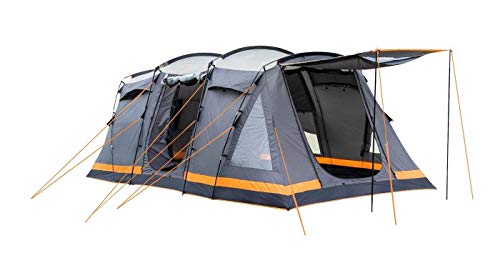
Olpro Orion 6 Berth Tent (Black/Charcoal, 5.5m x 2.4m)
Olpro
- 5000mm waterproof rating
- Versatile 3 or 6 berth
- Fully sewn groundsheet
- Roof skylight feature
- 20 minute setup time

Skandika Gotland Tunnel Tent (6 Person, Green/Grey)
Skandika
- 24m² spacious interior
- 5000mm waterproof rating
- Three separate entrances
- Sewn-in groundsheet protection
- Mosquito mesh doors

Coleman Steel Creek 6-Person Tent (Green, PFAS-Free)
Coleman
- WeatherTec waterproof system
- Integrated rainfly protection
- Screened porch area
- Fits queen-size airbed
- Pre-attached pole setup
What is a 6 man tunnel tent?
A tunnel tent is built from a row of parallel hoops - fibreglass poles or inflatable air beams - set one behind the other to make a long, round-topped shape. The sleeping area sits at the back, the living room in the middle and a porch or canopy at the front. In a six-berth model that adds up to an overall length of around 5.5 to 7 metres, with room to stand up through most of the tent.
Unlike a dome, a tunnel does not stand on its own. The hoops only hold their shape once the tent is pegged out at both ends and the guy lines are tensioned. In return you get near-vertical walls, more usable floor for the weight carried and a layout that divides neatly into separate rooms. It is the classic British family design for good reason: it copes well with wind and rain and gives you somewhere dry to cook, eat and play cards when the weather turns.
How many people really fit?
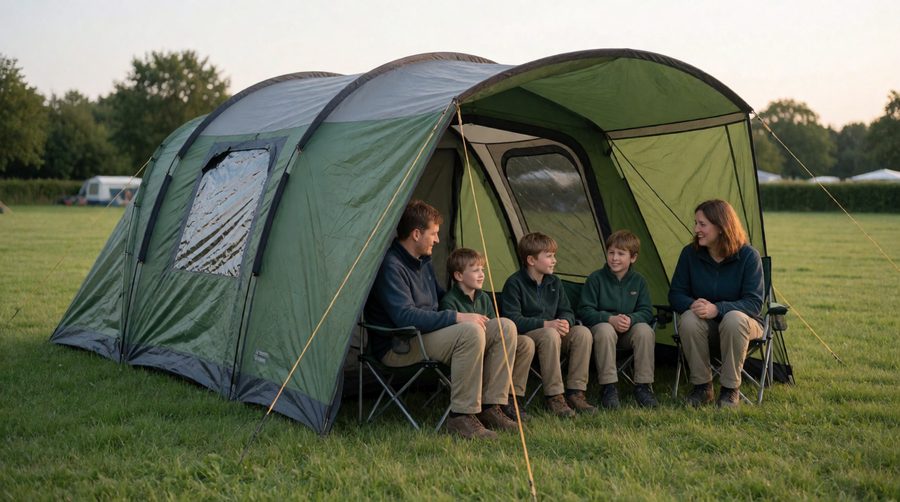
Berth ratings assume everyone lies shoulder to shoulder on a narrow mat with bags stored elsewhere. A standard self-inflating mat is about 60cm wide, so a bedroom needs to be roughly 360cm across to take six side by side. That is a useful test when you read the specs:
- Family of four: the most comfortable fit. Each person gets a full-size mat or airbed, with space at the foot of the beds for clothes and bags.
- Family of five or six with young children: it works well, especially in a tent with two or three separate cabins so parents and children can have their own room.
- Six adults: possible in the widest models, but tight. Expect to keep all luggage in the living area, and use single mats rather than double airbeds.
If you regularly camp with six adults or teenagers, step up to our 8 man tents or a 3 bedroom tent. For a smaller car or a family of three, our 4 man tents are lighter and quicker to pitch.
Our 6 man tunnel tents compared
These figures come from the manufacturers' specifications for the tents in stock in this collection.
| Tent | Frame | Pitched size (L x W) | Peak height | Weight | Flysheet | Layout |
|---|---|---|---|---|---|---|
| Trail Hexton XL 6 | Colour-coded fibreglass | 700 x 240cm | 210/220cm | 19.2kg | 5000mm | 2 bedrooms + living |
| Olpro Orion 6 | Steel legs + fibreglass roof | 550 x 240cm | 200cm | 18kg | 5000mm | 2 bedrooms + living |
| Portal Luxury 6 | 3 fibreglass poles | 560 x 380cm | 210cm | 17.5kg | 3000mm | 1 bedroom with divider |
| Skandika Gotland 6 | Fibreglass + steel uprights | 540 x 450cm | 210cm | 22.4kg | 5000mm | 1 cabin with partition |
| Kampa Hayling 6 Air | AirFrame beams | 690 x 380cm | 210cm | about 25kg | about 3500mm | 1 bedroom pod with divider |
| Outwell Colorado 6 Air | DuraAir beams | 565 x 380cm | 215cm | 28.4kg | 4000mm | 3 cabins + living |
A few patterns stand out. Weight runs from 17.5kg to 28.4kg, so every one of these is a car-camping tent rather than something to carry far from the car park. Peak height sits between 200cm and 220cm, so most adults can stand upright in the living room. And the two air beam tents are the heaviest of the six, because the beams, their sleeves and the valves weigh more than fibreglass poles.
Shape matters as much as size. The Hexton XL and Orion are long and narrow at 240cm wide, which suits a standard campsite pitch and makes them easier to guy out in wind. The Gotland and Portal are much wider at 450cm and 380cm, which buys a bedroom wide enough for six mats in a row.
Poled or air beam?
Both frames give you the same layout. The difference is in pitching time, weight, pack size and what happens when something breaks.
Poled tunnel tents
Fibreglass poles slide through sleeves on the flysheet, usually colour-coded so you know which goes where. They are cheaper, lighter and pack smaller: the Hexton XL packs into a 70 x 32 x 32cm bag, and the Orion into 75 x 30 x 30cm. A cracked pole section can be splinted with a repair sleeve on site. The downside is time - threading long poles on a breezy evening needs two people and a bit of patience, and Olpro quotes around 20 minutes for the Orion.
Air beam tunnel tents
Air tents have their beams built into the fabric. Peg the corners, connect the pump to each valve and the frame rises in minutes - Kampa quotes 9 minutes for the Hayling 6 Air, and Outwell 12 minutes to get the Colorado 6 Air ready to move into. Beams flex rather than snap in gusts, which many families like. The catch is bulk: the Colorado packs to 95 x 46 x 44cm and the Hayling to 80 x 44 x 44cm, a large share of an estate car boot. Before you buy, check that replacement beams are sold for that model, so one puncture doesn't end the tent's life. Our 4 man inflatable tents page covers air frames in more detail.

Bedroom layouts: one big room or separate cabins?
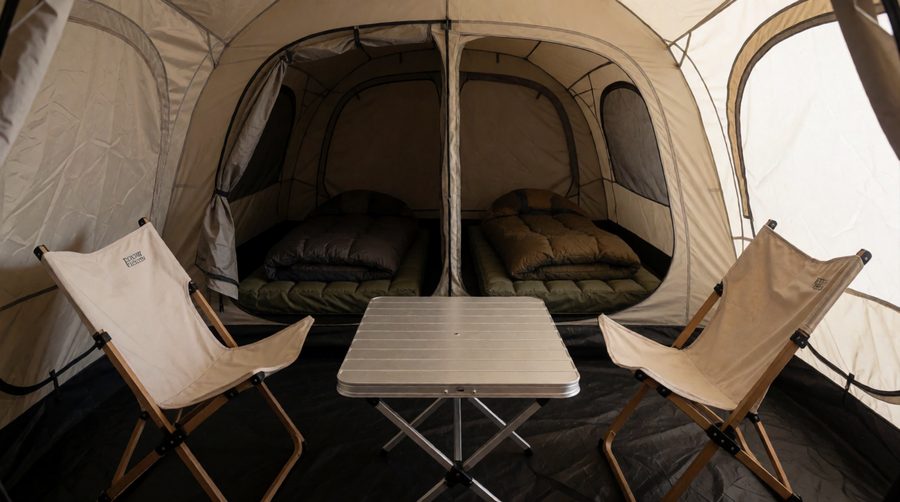
The biggest difference between models is how the sleeping space is split.
- One wide bedroom with a divider: the Portal Luxury has a single 380 x 210cm bedroom (7.56 square metres) that splits into two, and the Gotland's 420 x 215cm cabin has a partition. Good for families with young children who want everyone together, and flexible as the children grow.
- Two separate bedrooms: the Hexton XL puts a 210 x 220cm darkened bedroom at each end of a central living area, each wide enough for three mats. Parents sleep at one end and children at the other, with the living room between them.
- Three cabins: the Colorado 6 Air has three darkened sleeping cabins, the most privacy for groups of friends or families with teenagers.
Look for darkened or blackout bedrooms if you have young children or light sleepers. In June the sun is up before 5am across most of the UK, and a dark inner makes a real difference to how long everyone sleeps. Our blackout tents collection has more options with this fabric.
How to choose the right one
Waterproofing
Waterproofing is measured as hydrostatic head (HH): the height in millimetres of a column of water the fabric holds back before it leaks. Around 1,500mm is generally treated as the minimum for a fabric to be called waterproof. 3000mm, as on the Portal, handles normal summer showers; 4000-5000mm, as on the Colorado, Hexton XL, Orion and Gotland, gives more margin for long, wind-driven rain and for fabric that loses a little coating with age. Fully taped seams and a sewn-in groundsheet matter just as much as the HH figure.
Weight and pack size
Measure your boot before you buy. Every model here weighs more than 17kg and most pack to around 75-95cm long, before you add sleeping bags, mats and a cool box. If space is tight, choose a poled tent over an air frame.
Living space and porch
Check the living room length, not just the overall length. The Hexton XL's living area is 240 x 240cm, enough for a table and six chairs. A front canopy or porch gives you a covered spot for muddy boots and wet coats. Never cook in the tent itself.
Ventilation and condensation
Six people breathing overnight put a surprising amount of moisture into the air. High and low vents, mesh panels on doors and windows, and a double-skin design (an inner tent hung inside the flysheet) keep condensation off your sleeping bags. Open the vents even when it is cold.
Pitching in wind and rain
Tunnel tents are very stable when pitched properly, and less forgiving when they are not. Point the narrow rear end into the prevailing wind so gusts slide over the hoops rather than hitting the broad side. Peg both ends fully before inflating or tensioning the poles, then put out every guy line - they are part of the structure, not an extra. The Hexton XL and the Trail range use a multi-point guying system for this reason.
Check the forecast before you go. Most family tents are not designed for gales, and the Met Office's Beaufort scale guide is a handy way to read wind speeds. On an exposed coastal pitch, consider dropping the front canopy and adding storm straps if your model has them.
Staying safe in a family tent
Never take a barbecue, gas heater or stove into a tent or porch, even after it has stopped burning. Charcoal and gas give off carbon monoxide, which you cannot see or smell. The NHS lists the symptoms of carbon monoxide poisoning, and the Camping and Caravanning Club's campsite safety advice recommends a Kitemarked CO alarm hung inside the tent as a back-up.
Tunnel, dome, inflatable or bell?
If a tunnel isn't quite right, a large dome tent stands on its own and suits rocky ground where pegging is hard. A bell tent gives a single round room in canvas, popular for glamping and festivals. And if you are planning for a bigger group or more privacy, browse our 4 bedroom tents or 10 person tents.
Frequently asked questions
How big is a 6 man tunnel tent?
Most are 5.4 to 7 metres long and 2.4 to 4.5 metres wide, with peak heights of 200-220cm. The models in our range cover roughly 13 to 26 square metres of floor.
How much does a 6 man tunnel tent weigh?
Poled tents here weigh 17.5-22.4kg; the air beam versions 25-28.4kg. All are designed for carrying from the car to the pitch, not for backpacking.
Is 3000mm waterproof enough?
For spring and summer camping in the UK, yes, provided the seams are taped and the tent is pitched taut. If you camp in autumn or on exposed sites, 4000-5000mm gives more margin.
Can six adults sleep in one?
Only in the widest models, and it will be snug. A bedroom needs about 360cm of width for six 60cm mats; the Portal (380cm) and Gotland (420cm cabin) manage it. Most families find six berths ideal for four or five people.
Are tunnel tents good in wind?
Yes, when pitched with the narrow end into the wind and every guy line pegged out. Pitched side-on with loose guys, they can flex a lot.
How long does it take to pitch?
Expect 15-25 minutes for a poled tent with two people, once you have done it once at home. Air tents are quicker: around 9-12 minutes for the Kampa and Outwell models. Full room sizes for the Hexton XL are on Trail's product page, and Countryfile has a hands-on review of the Olpro Orion.