


8 Man Tents
8 man tents are built for big families and groups of friends who want to camp together under one roof, with separate bedrooms for sleep and a living area tall enough to stand up, cook a rainy-day breakfast and play cards when the weather turns. You will find tunnel, dome and inflatable air designs below, from lightweight 8kg domes to heavy-duty family tents with blackout bedrooms.
Sleeping ten or more? Step up to our 10 person tents. Want the bedrooms spelled out? Browse 3 bedroom tents for layouts with a pod for parents and two for the children.

Olpro Stafford 8.0 (Grey Black & Blue, 8 Berth)
Olpro
- 8 berth tunnel tent
- Recycled plastic bottle fabric
- Sewn-in groundsheet protection
- Blackout bedroom compartments
- 5,000mm waterproof rating

Vakiorn Inflatable Tent (Brown, 3x4M With Chimney)
Vakiorn
- Quick 20-minute setup
- 4-8 person capacity
- Waterproof Oxford cloth
- Chimney opening included
- Storage bag provided

Vidalido Ansan-Khaki-Plus (8-10 Person, Khaki)
Vidalido
- 8-10 person capacity
- Two room design
- Extended front vestibule
- 1500mm waterproof coating
- Dual mesh windows

Afitdon Inflatable Tent (4-10 Person, 12m²)
Afitdon
- 5-minute quick setup
- 420D waterproof Oxford fabric
- Built-in PVC air columns
- Multiple size options
- Includes air pump

GoHimal 8 Person Camping Tent (Green, 4.29m x 2.41m x 1.93m)
GoHimal
- Waterproof PU2000mm coating
- 4 separate room sections
- 10 minute assembly time
- Strong fibreglass pole frame
- 4 mesh windows ventilation

Hi-gear Zenobia Eclipse 8 Man Tent (Blue, 7m x 3.1m)
Hi-gear
- Eclipse darkened bedroom system
- 4000mm waterproof rating
- 20 minute setup time
- Two separate bedrooms
- Sewn-in groundsheet protection
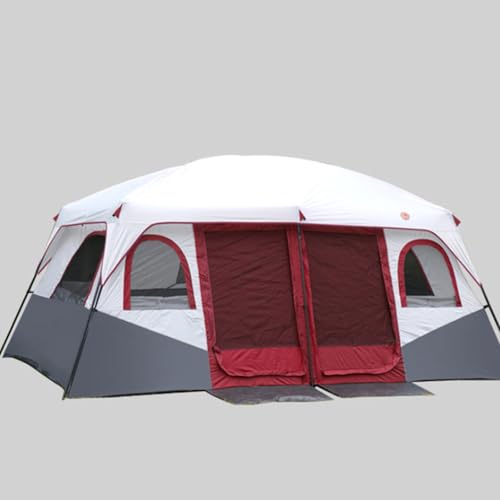
QJWM 8-12 Person 3 Season Camping Tent (Red/Blue)
QJWM
- Accommodates 8-12 people
- Separated room with curtain
- 6 mesh windows
- 3-minute setup time
- 4800mm water resistance

Campros CP Tent 8 Person (Blue, 366cm x 274cm)
Campros
- 8 person capacity
- 1000mm waterproof rating
- 5 minute setup
- 193cm standing height
- Mesh roof stargazing

Berghaus Kepler 9 Nightfall (Grey, 9 Person)
Berghaus
- Nightfall darkened bedrooms
- Quick inflatable air beams
- 6000mm waterproof rating
- Built-in enclosed porch
- Three separate bedrooms
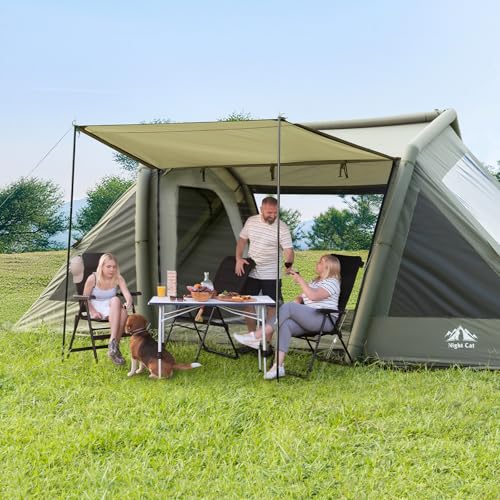
Night Cat Inflatable Tent ZP-F2 (Green, 8 Person)
Night Cat
- Quick inflatable setup
- Two separate bedrooms
- PU 3000mm waterproof
- Four season design
- Transparent PVC windows

Coleman Skydome Dark Room Tent (8-Person, Blue)
Coleman
- Blocks 90% sunlight
- Sets up under 5 minutes
- 20% more headroom
- WeatherTec water protection
- Fits 2 queen airbeds

WaldWander Inflatable Tent (Green, 6-10 Person, 400 x 300 x 200 cm)
WaldWander
- Inflates in 5-10 minutes
- 3000mm waterproof rating
- 12 square metre floor space
- No poles required
- Hand pump included

Loyeahcamp 8 Person Extended Dome Tent (Grey/Blue, 427cm x 244cm)
Loyeahcamp
- Spacious 8 person capacity
- Three separate room design
- 2000mm waterproof coating
- Quick 10 minute setup
- Multiple ventilation windows

Skandika Montana 8-10 Person Tent (Blue, 700 x 310 x 200cm)
Skandika
- Sleeper Technology blocks light
- Accommodates 8-10 people comfortably
- 5000mm waterproof rating
- Three separate sleeping cabins
- Multiple entrances and windows
What is an 8 man tent?
An 8 man tent (also sold as an 8 person or 8 berth tent) is rated to sleep eight people lying side by side on mats. That rating is the maximum, not the comfortable number. Makers count sleeping spaces, not the room you need for bags, camp beds and a cool box, so most campers size up. The Camping and Caravanning Club's advice is simply to buy a tent with more berths than campers.
In practice, that means an eight-berth tent is ideal for a family of five or six who want space to spread out, or for two families sharing. Eight adults can sleep in one, but it will feel tight on a wet day. If that is your plan, look at our 10 person tents instead.
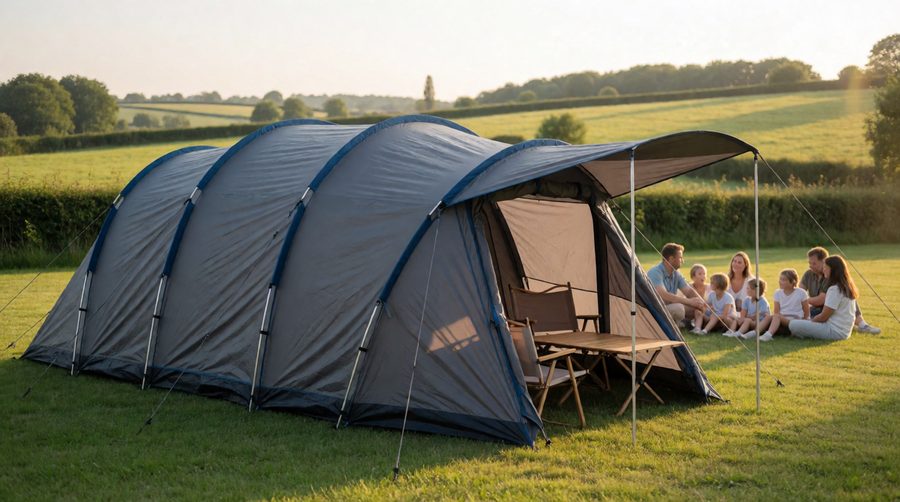
8 man tents compared: real sizes, weights and ratings
Here are the in-stock 8 man tents from this collection side by side, using the maker's own figures. Hydrostatic head (HH) is the flysheet's waterproof rating in millimetres; the higher it is, the more rain the fabric can take before it lets water through.
| Tent | Type | Size (L x W) | Peak height | Bedrooms | Weight | Flysheet HH |
|---|---|---|---|---|---|---|
| Berghaus Kepler 9 Nightfall | Air tunnel | 785 x 235cm | 213cm | 3 (blackout) | 42kg | 6,000mm |
| Olpro Stafford 8.0 | Poled tunnel | 700 x 300cm | 210cm | 3 (blackout) | 28kg | 5,000mm |
| Hi-Gear Zenobia Eclipse 8 | Poled tunnel | 700 x 310cm | 205cm | 2 (darkened) | 23.5kg | 4,000mm |
| QJWM 8-12 Person | Poled | 430 x 305cm | 203cm | 2 | 14kg | 4,800mm |
| Night Cat ZP-F2 | Inflatable tunnel | 630 x 270cm | 205cm | 2 + living area | 16kg | 3,000mm |
| WaldWander Inflatable 6-10 Person | Inflatable | 400 x 300cm | 200cm | 1 open room | 12.5kg | 3,000mm |
| Vidalido Ansan Plus | Poled | 400 x 300cm | 205cm | 2 | 12.56kg | 1,500mm |
| Campros CP 8 Person | Dome | 366 x 274cm | 193cm | 1 | 9.89kg | 1,000mm |
| GoHimal 8 Person | Dome | 429 x 241cm | 193cm | Not stated | 7.7kg | 2,000mm |
Three things stand out. Weight runs from 7.7kg to 42kg, so the same "8 person" label covers a tent you can carry in one hand and one that needs two adults to lift. Waterproofing ranges from 1,000mm to 6,000mm. And only the tunnel designs pair 200cm+ headroom with separate bedrooms and a proper living area.
Types of 8 man tents
Tunnel tents
Most family tents sold in the UK are tunnels: a row of hooped poles or air beams with bedrooms at the back and a living area at the front. They give the most usable floor space and headroom for the weight, and they are straightforward to pitch, though they must be pegged out before the wind catches them. The Olpro Stafford 8.0 and Hi-Gear Zenobia Eclipse 8 are good examples. Our 6 man tunnel tents use the same design on a smaller footprint.
Air tents
Air tents replace poles with inflatable beams. You peg the corners, pump the beams and the shape stands up in minutes, which is a real advantage on a large tent. They are usually heavier and bulkier than poled equivalents and cost more, but there are no poles to snap and the beams flex in gusts rather than breaking. Browse our 6 berth inflatable tents if you like the idea but need slightly less room.
Dome and cabin tents
Dome tents are self-supporting, so you can pick one up and move it before pegging. Larger domes are cheaper and far lighter, but they lose headroom towards the walls and are less stable in strong wind. Many budget eight-person domes are made for the US market: the Coleman Red Canyon and Wenzel Klondike both have over 3,000 Amazon ratings, but their flysheets are rated at 1,500mm and 1,200mm. That is fine for dry weekends, less so for a week on the Cornish coast. See our large dome tents for the full range.
Bell and polycotton tents
Canvas and polycotton tents breathe better, stay cooler in sun and are quieter in wind and rain, but they are heavy and need weathering before first use. A 5m bell tent is the usual polycotton alternative to an 8 man family tent.
How to choose an 8 man tent
Floor size and campsite pitches
Check the full footprint, guy lines included, before you book a pitch. The Camping and Caravanning Club charges for a Jumbo Pitch on its own sites when a tent measures more than 5m x 9m, and many smaller campsites set similar limits. Most eight-berth tunnels in our range are 7-8m long, so they fit a standard pitch, but large air tents with an extended porch can tip over.
Bedrooms and blackout
Count bedrooms, not berths. Two or three separate inner tents let parents and children sleep apart and keep bags out of the living area. Blackout or darkened bedrooms (Berghaus Nightfall, Hi-Gear Eclipse, Coleman Dark Room) cut early sunrise and help children sleep past 5am in June. Our blackout tents page covers how they work. For larger groups, 4 bedroom tents add a fourth pod.
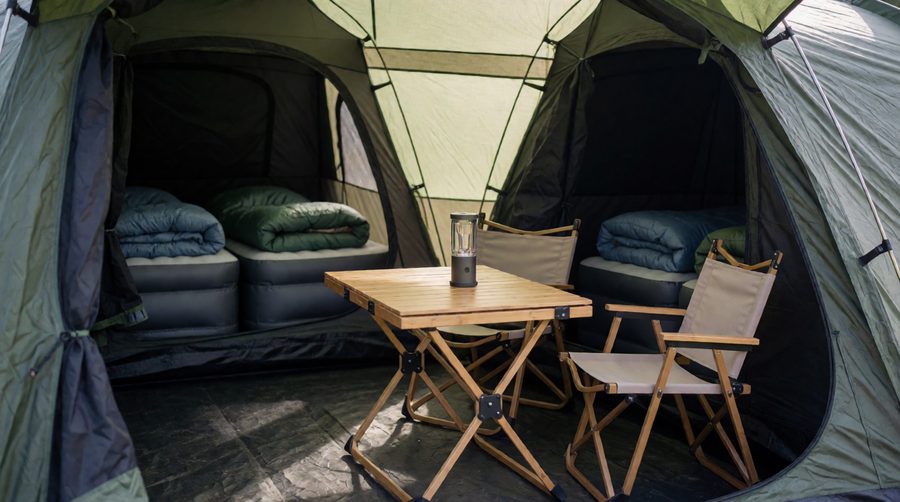
Headroom and living space
The single most useful figure is peak height. At 200cm or more, most adults can stand upright in the living area, which matters on a rainy afternoon. Domes at 183-193cm will have you stooping. Look at the living area size too: the Skandika Montana, for example, has a 250 x 310cm living room in front of three bedrooms.
Waterproof rating
Cheap polyester tents are usually around 2,000mm; UK family tents from established brands tend to start at 3,000mm and go up to 6,000mm. A higher number helps, but the Club points out that most leaks come through seams, zips and doors rather than the fabric. Taped seams, a sewn-in groundsheet and a covered entrance matter just as much. You can read its guide to choosing a tent for more.
Weight and packed size
A family poled tent starts at around 10kg and big air or polycotton models can exceed 60kg, according to the Club. In our range, the Kepler 9 packs to 90 x 66 x 60cm and 42kg, while the GoHimal folds down to 7.7kg. Measure your boot before you buy, and remember chairs, beds and a cool box need room too.
Pitching time and number of people
Big poled tents usually need two adults, and the first pitch always takes longest. Air tents are faster: inflate, peg out and tension. Whichever you choose, have a practice pitch in the garden before your first trip.
Is an 8 man tent the right size?
- Family of four: an 8 man tent is generous. A 6 man tent is lighter and often plenty.
- Family of five or six: the sweet spot. Bedrooms for everyone plus a real living space.
- Two families or a group of friends: look for three bedrooms and two doors so people are not climbing over each other.
- Eight adults: size up to 10 berths, or pair a smaller tent with an event shelter.
If you are four adults and like a bit of space, our 4 man tents and 5 man tunnel tents are much easier to pitch and pack.
Staying safe in a large tent
Never bring a barbecue, stove, gas heater or generator into a tent or porch, even once it has stopped burning. They give off carbon monoxide, which has no smell and can kill in an enclosed space. Signs include headache, dizziness, nausea and drowsiness; the NHS guide to carbon monoxide poisoning explains what to do. The Club's camping safety advice also recommends a CO alarm tested to BS EN 50291-2, cooking outside, and keeping at least 6m between tents so a fire cannot spread.
8 man tents FAQs
How many people really fit in an 8 man tent?
Eight on mats at a squeeze, five or six in comfort with camp beds and luggage. Treat the berth number as a maximum.
How big is an 8 man tent?
Most tunnels are around 7m x 3m (the Olpro Stafford 8.0 is 700 x 300cm). Domes are smaller at roughly 4 x 2.5m, with less headroom.
How heavy is an 8 man tent?
Anything from under 8kg for a basic dome to over 40kg for an air tent with heavy fabric. Poled tunnels sit around 20-30kg.
Is an air tent or a poled tent better?
Air tents pitch faster and have no poles to break; poled tents are lighter and usually cheaper. For a big family tent pitched often, many people think the speed of air is worth it.
What waterproof rating does an 8 berth tent need in the UK?
Aim for 3,000mm or more, with taped seams and a sewn-in groundsheet. Under 2,000mm is best kept for dry summer weekends.
Do 8 man tents need a bigger campsite pitch?
Usually not. Most fit a standard pitch, but Camping and Caravanning Club sites charge for a Jumbo Pitch above 5m x 9m, so check before booking.